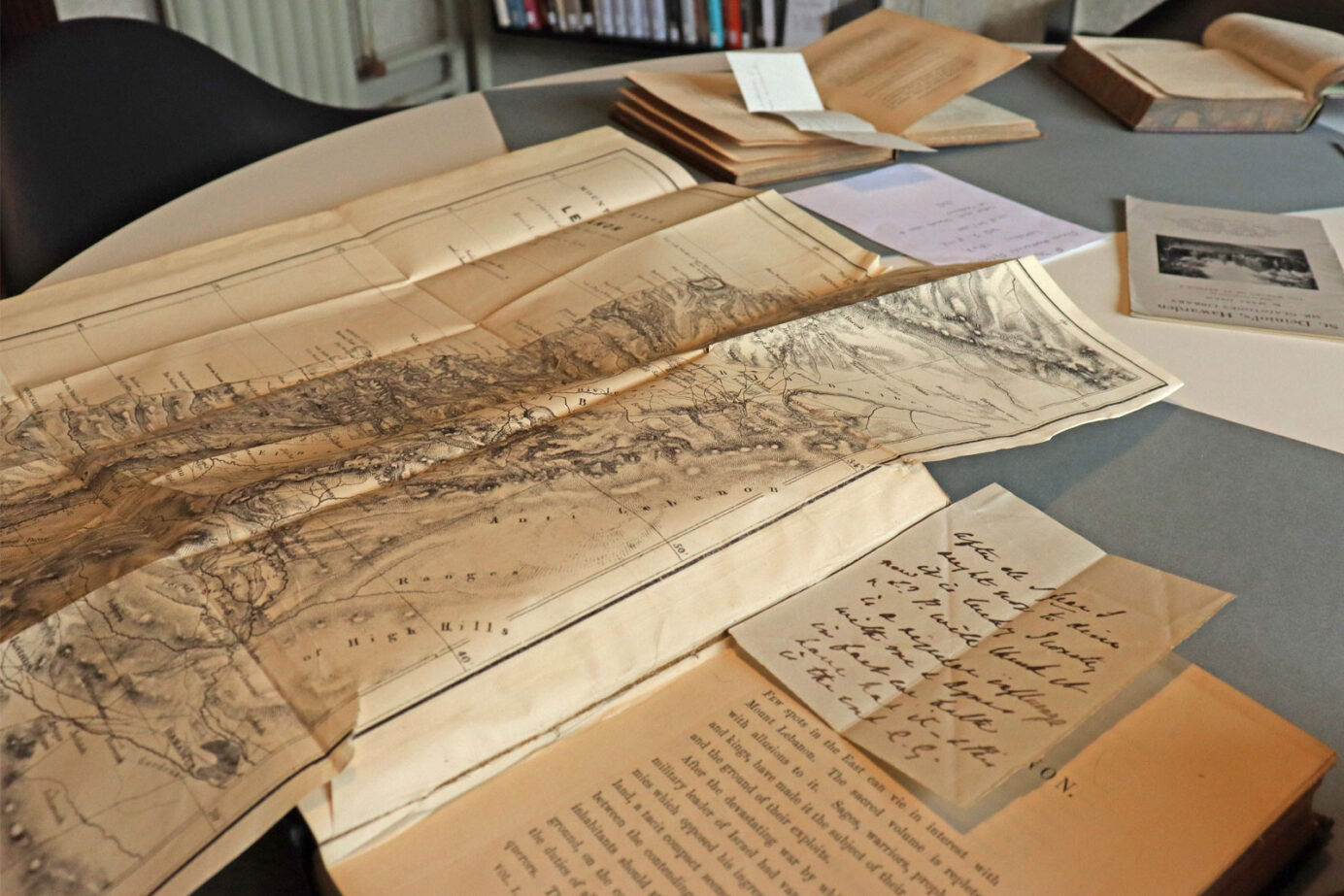
Archives and special collections are available for scheduled viewings Monday to Friday, 9:30am-1pm and 2pm-4:30pm.
To view items in our archives and special collections you must make an appointment for a viewing using the process in the relevant section below.
Please contact us to make your appointment as far in advance of your proposed visit as possible so that you can definitely book a space as we can be very busy and occasionally the Reading Rooms close for special events and collections care.
To avoid disappointment, make sure your appointment has been confirmed before you book your accommodation and travel.
Search Catalogues
You must allow at least 14 days’ notice to enable us to do condition checks and so that we can check whether there are any data protection issues that may prevent your access to any items from the archives that you would like to view.
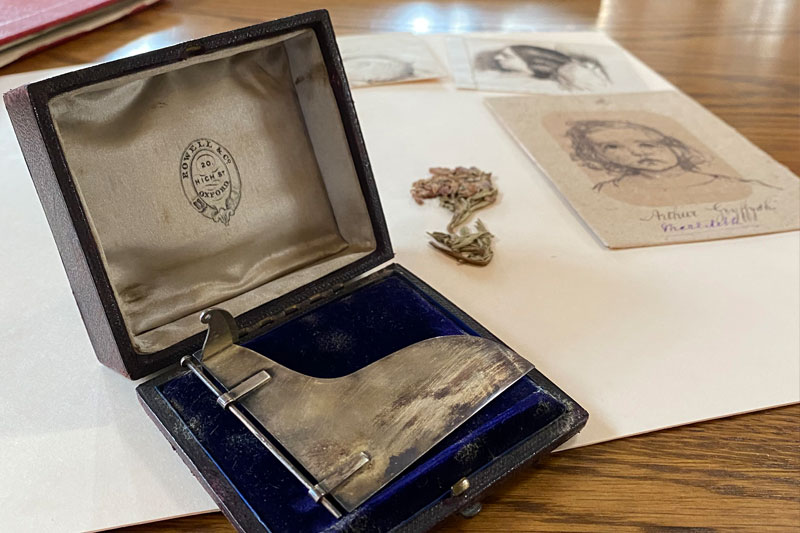
To view archives and special collections you need to be a Resident at the Library, a registered Reader, or sign up as a Researcher for the day.
You will need to bring photographic ID and proof of your address.
If you have any questions about our archives and special collections, please email library@gladlib.org.
You can find out about what archives we hold here.
To arrange a viewing, complete the Request to View Archives form (editable word document here) and email it to library@gladlib.org at least 14 day’s prior to your intended visit.
The Reading Rooms team will be in touch to arrange your viewing.
Access to some of the items in our archives are restricted under data protection legislation. In these cases, they may only be viewed by individuals completing historical, scientific, or statistical research and with a view to publish some journalistic, academic, artistic, or literary material that is in the public interest. This applies to many of the records we hold that were created in the last 100 years. If any of the material that you have requested does contain personal data, you will be sent an application form that enables us to check that your request is lawful.
A maximum of ten folders will be retrieved on any one day and some items are too fragile to be photographed, so please take this into consideration when planning your trip to the library.
You can find out about what special collections we hold here.
To arrange a viewing, complete the Request to Read Restricted Printed Collections form (editable word document here), and email it to library@gladlib.org at least 14 day’s prior to your intended visit.
The Reading Rooms team will be in touch to arrange your visit. They’ll also make sure that all the items you wish to use are accessible and in reasonable condition. If there are any problems, they’ll let you know in good time.
View our Printed Collections Handling Guidelines which you’ll be asked to sign as part of your visit.
Please note that items will be given to you in the order that you request them, and also that we can only retrieve a certain number of items in a day. Our team will advise you.
All archives and special collections are viewed at our supervised invigilation desk in the Reading Rooms.
As is standard practice in libraries while consulting archives and special collections, you are not allowed coats, bags, food, or liquids, including bottles of water and pens, at the table with you. Lockers are available for you to leave your belongings in.
To take notes, please use a pencil and paper, and/or a laptop/tablet.
Archives and special collections will be given to you one folder or bound item at a time.
We don’t wear gloves to handle archives and special collections because they make it more likely an item will be torn. Instead always handing items with clean, dry hands are the best way to look after them. The oils from your hands, as well as moisturiser and hand sanitiser, will slowly stain the paper. Please wash and thoroughly dry your hands before handling archives and special collections.
All archives and special collections are unique either because they are the only copy of that item that exists or because they were owned by a notable individual, so handle all items carefully regardless of their age.
If you notice any damage to items, or if an item becomes damaged while issued to you, let the person on the Enquiry Desk know as soon as possible.
When you have finished looking at something, please do not carry it to the Enquiry Desk. The person on the Enquiry Desk will retrieve it for you and issue you with the with the next item you had requested to see.
All items need to be returned at 1pm and 4:30pm, and any time you intend to leave the reading rooms for lunch or for a break.
We reserve the right to withdraw items or to ask you to view a digital copy of the original item (if one is available) if the item is too fragile to be handled safely.
If this is your first time using archives and special collections and you would like some support or if you have any questions at all, please don’t hesitate to ask a member of our Enquiry Desk staff– we are very happy to help! We want you to feel confident and at ease.
Please use a book cushion to support the spine of bound items.
Use snake weights to hold pages down where they do not naturally lie open. Carefully rest snake weights over the corners of pages of books and only rest them on the white spaces of the page, avoiding any text.
Never force open a volume with a tight binding.
Do not lick fingers to separate pages.
Avoid touching the surface of text, illustrations, or illuminations.
Do not use your finger to follow the line of text you are reading – use an acid-free card strip (available on request).
Keep items in the order they are given to you. In archives we preserve the order the creator of a collection kept them in wherever possible. This can tell us as much about a person as the content of the records themselves.
Papers should rest flat on the tabletop. Please don’t lift items to try to read them. Magnifying glasses are available if you are struggling to read an item.
Handle items by the edges using two hands, and avoid touching the surface of text, illustrations, or wax seals.
Consult loose papers one at a time, turning pages one by one.
Do not lick fingers to separate pages.
Do not lean or put pressure on items while using them and do not put any of your belongings on top of the items.
Do not use your finger to follow the line of text you are reading – use an acid-free card strip (available on request).
Remove any paperclips from pages when you are opening them up and turning them and then make sure you put the paperclip back in the right place.
If you need to keep your place in a folder or bound volume, please use an acid-free card strip.
Do not square papers by tapping their edge on the table top, keep papers aligned as you turn them.
Some files may contain sub-folders that indicate that they contain fragile items. Please be particularly careful when handling these items.
If you would like to take photographs of any of our archives and special collections using a small digital camera or the camera on your mobile telephone or tablet during your viewing you must complete one of our Self-Service Photography Forms. There is a charge of £5 for a day or £10 for a week.
DSLR cameras and other high-resolution devices such as hand-held scanners are not permitted.
If you are taking photographs of items, please make sure that you are still handling items carefully at all times and bear in mind that some items may be too fragile to photograph.
Archives and special collections should not be placed on a copier. If you would like to have an item digitised and emailed to you, please complete our Reprographics Form.
Due to copyright law, any images of archives must be either for your own research purposes or for in-person education unless a Licence Agreement Form has been completed and signed to indicate that appropriate rights clearance checks have been performed. Images cannot be shared, published, or put online in any manner.
Items containing personal data cannot be photographed or scanned due to data protection laws.